


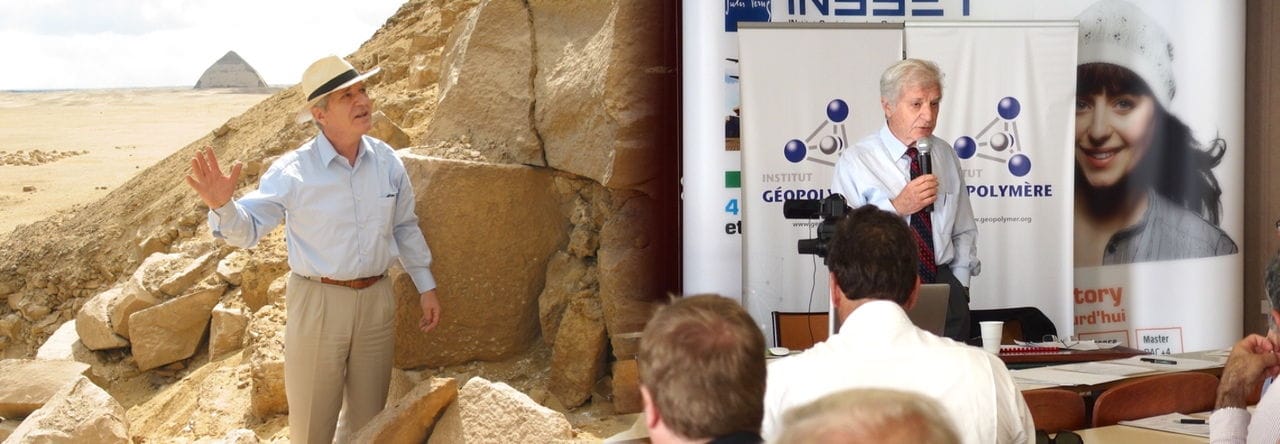
Professor Joseph Davidovits was born on March 23, 1935, in Villers St Paul, Oise, Frtance. He is known by the scientific community for being the inventor of geopolymer science. The general public recognizes his works on archaeological science and his discoveries regarding building the pyramids in Egypt. He posited that the blocks of the Great Pyramid are not carved stone but mostly a form of limestone concrete or man-made stone. This odd theory is officially endorsed by several renown materials scientists. He holds the French “Ordre National du Mérite”, is the author and co-author of numerous scientific papers and conferences reports, and holds more than fifty patents.
In 1958, he obtained a chemical-engineer degree (Ingénieur-chimiste) at the Ecole Nationale Supérieure de Chimie, Rennes, France followed by a Dr.rer.nat in organic polymer chemistry at the University of Mainz, Germany in 1960. Between 1962 to 1972, he researched in organic polymers for the textile industry in France. In 1964, he received the Annual Award from the French Textile Chemical Society for his work on linear organic polymers. In 1969, he is hired by the French textile company, Delcer Industries, and creates a research laboratory dedicated to organic polymer chemistry, in Saint-Quentin, Aisne, France. However, in the aftermath of various catastrophic fires in France between 1970-72, which involved common organic plastic, he decided to carry out research into new heat-resistant and fire-resistant mineral polymers. In 1972, he founded in Saint-Quentin the private research company Cordi (SA) (called later Cordi-Géopolymère SARL), a family owned company. All publications related to the research from 1972 to 1979 on alumino-silicate solid-state chemistry are pertaining to the patent literature.
The geopolymer concept was created and published in 1979, together with the foundation of the non-profit scientific organization Geopolymer Institute, Saint-Quentin, Aisne, France. In 1983, he was appointed Professor of Chemistry at Barry University, Miami, Florida, and there he founded the Institute for Applied Archaeological Sciences (IAPAS) to study worthwhile ancient technologies and advance the clarity of ancient history. Between 1983 and 1989, in collaboration with Lone Star Industries of the United States, he developed the geopolymer cement called PYRAMENT and its associated cement blends. For this breakthrough in cement technology, the National Association for Science, Technology and Society (NASTS) and the Federation of Materials Societies, USA, gave him the Gold Ribbon Award in 1994, jointly with James Sawyer from Lone Star Industries. He was an active member of several scientific societies including American Chemical Society, American Ceramic Society, American Concrete Institute, New York Academy of Sciences and International Association of Egyptologists. In 2008, he started publishing the reference text book « Geopolymer Chemistry and Applications » that he is still updating on a regular basis (5th edition is released in March 2020). In 2015, he is launching the first “Journal on Geopolymer Science” with the publisher Elsevier.
He is the President of the Geopolymer Institute and Chair of the annual conference Geopolymer Camp, Saint-Quentin, France. This is a workshop-conference aimed at gathering academic as well as industrial scientists willing to meet, share and learn about geopolymers at large. Professor Davidovits’ research is applications driven and his main undertaking is to ensure the industrial success of this new chemistry in the following fields: fire resistant materials, decorative stone artifacts, thermal insulation, low-tech building materials, low energy ceramic tiles, refractory items, thermal shock refractories, foundry applications, eco-cements and concretes, composites for infrastructures repair and strengthening, high-tech composites for aircraft interior and automobile, high-tech resin systems, radioactive and toxic waste containment, arts and decoration, cultural heritage, archaeology and history of sciences.
Background of Professor Joseph Davidovits
- International renown French Scientist, born on March 23, 1935 in Villers-St-Paul, Oise, France; working in France, Europe, USA, Australia and China.
- Honored with one of France’s two highest honors, the grade of ” Chevalier de l’Ordre National du Mérite ” (Nov. 1998).
- Discoverer and inventor of the geopolymer chemistry and its technical applications.
- Author and co-author of more than 130 scientifical papers and conferences, and more than 50 patents.
- 2008 – 2020, first reference book on geopolymer science, Geopolymer Chemistry & Applications Institut Géopolymère (Geopolymer Institute), Saint-Quentin, France, 5th ed. published March 2020, ISBN 978-2-9544531-1-8.
Archaeology
Professor Joseph Davidovits has also presented different papers and studies in ceramics, ancient cement and roman concrete in several congresses in archaeology and archaeometry.
He is mainly well-known by the general public for its theory on the method of building the pyramids of Egypt with re-agglomerated stones, say a natural limestone manufactured like a concrete.
Member of the International Association of Egyptologists, he presented several conferences on ceramics, blue faience, cements, pigments, and the analysis of pyramids stones at several International Congresses of Egyptology in 1979 (Grenoble, France), 1982 (Toronto, Canada), 1988 (Cairo, Egypt), 2004 (Grenoble, France).
Authors of several books:
(see the list of French and foreign languages at Books-Livres)
- 1988, The Pyramids: An Enigma Solved, Hippocrene, New York.
- 2002, Ils ont bâti les pyramides édition Jean-Cyrille Godefroy, Paris, ISBN 2-86553-157-0.
- 2004, La nouvelle histoire des pyramides d’Egypte édition Jean-Cyrille Godefroy, Paris, ISBN 2-86553-175-9.
- 2005, La Bible avait raison t.1, l’archéologie révèle l’existence des Hébreux en Égypte édition Jean-Cyrille Godefroy, Paris, ISBN 2-86553-182-1.
- 2006, La Bible avait raison t.2, sur les traces de Moïse et de l’Exode édition Jean-Cyrille Godefroy, Paris, ISBN 2-86553-190-2.
- 2008 They built the Pyramids, ed. Geopolymer Institute (Institut Géopolymère), Saint-Quentin, ISBN: 2-9514820-2-7.
- 2008 Geopolymer Chemistry & Applications Institut Géopolymère (Geopolymer Institute), Saint-Quentin, France, 5th ed. published in March 2020, ISBN 978-2-9544531-1-8.
- 2009 Et de cette fresque naquit la Bible , éditions Jean-Cyrile Godefroy, Paris. ISBN 978-2-86553-216-2.
- 2009 Why the Pharaohs built the Pyramids with fake stones, ed. Geopolymer Institute (Institut Géopolymère), Saint-Quentin, ISBN: 2-9514820-4-3.
- 2017, Bâtir les Pyramides sans pierres ni esclaves édition Jean-Cyrille Godefroy, Paris, ISBN 9782865532889.
Education
- French Degree in Chemical Engineering, Ecole Nationale Supérieure de Chimie, Rennes, France.
- German Doctor Degree in Chemistry (PhD), University of Mainz, Germany.
- Professor and founder of the Institute for Applied Archaeological Sciences, IAPAS, Barry University, Miami ,Florida, (1983-1989).
- Visiting Scholar, Penn State University, Materials Research Laboratory, Pennsylvania, USA (1989-1991).
- Honorary Professor, Xian Universtity of Architecture and Technology, China (1999).
- 1979 to present: Professor and Director of the Geopolymer Institute , Saint-Quentin, Aisne, France.
- 2001-2008: Research Director at CORDI-Géopolymère, Saint-Quentin, Aisne, France .
- 2008-2020, first book on geopolymer science Geopolymer Chemistry & Applications Institut Géopolymère (Geopolymer Institute), Saint-Quentin, France, 5th ed. 2020, ISBN 978-2-9544531-1-8.
Professional expertise
- World expert in Modern and Ancient Cements.
- World expert in Geosynthesis and man-made rocks.
- Consultant (expert) to the European Union Commission.
- Inventor of Geopolymers and the chemistry of Geopolymerization.
- Polyglot: English, French, German, Spanish, Latin, Ancient Greek, Hieroglyphs
Member of the following societies
- American Ceramic Society
- International Association of Egyptologists
- New York Academy of Sciences
- American Concrete Institute (former member)
- American Chemical Society (former member)
International Scientific Awards
- NASTS Gold Ribbon, awarded at the National Press Club, Washington DC, Sept. 26, 1994, by the National Academy of Engineering, The Federation of Materials Societies and the National Association for Science, Technology and Society.
- Honorary Membership awarded by the National Noise Observatory of the Czech Republic (Narodni Hlukova Observator CR), Prague (Czech Republic), 04 Nov. 2005
Extended Biography
He is the author and co-author of approx. 130 publications including 50 patents issued and granted related to research dedicated to applied solid-state chemistry, geopolymeric materials.
1958: Diplome d’Ingénieur-Chimiste, Ecole Nationale Supérieure de Chimie, Rennes, France
1960: Dr. rer. nat in macromolecular chemistry, University of Mainz, Germany.
From 1962 to 1972: 10 years dedicated to research and developments dealing with organic polymers, which resulted in 19 publications involving the chemistry of poly-urethane, textile synthetic fibers, biological membranes and collagen.
1964 Annual Award from the French Textile Chemical Society for works performed on linear organic polymers
In 1972, in the aftermath of various catastrophic fires in France in 1970 involving inflammable organic plastics, he decided to carry out research into new heat-resistant materials. Creation of the French private Research Company CORDI (SA) (called now CORDI-GÉOPOLYMÈRE SARL) (family owned company), in Saint-Quentin, Aisne, France. From 1972 until 1979, all publications related to this 7 year long research on alumino-silicate solid-state chemistry are pertaining to the patent literature. The “Geopolymer” concept was created and published in 1979, together with the foundation of the non-profit organization GEOPOLYMER INSTITUTE, in Saint-Quentin, France. More than 50 publications are disclosing 20 years of research and developments carried out in Europe and in USA on the applications of geopolymeric solid-state chemistry, with major breakthroughs in high-tech composite materials, cement-technology and the containment of radioactive and other hazardous waste.
In 1983 he was appointed Adjunct Professor of Chemistry at Barry University, Miami, Florida, and there he founded the Institute for Applied Archaeological Sciences (IAPAS). The IAPAS is established to study worthwhile ancient technology and advance the clarity of ancient history. The main focus has been on researching ancient cements in order to understand their long-term durability and test their performance of their modern counterparts (the said geopolymeric binders) for toxic and radioactive wastes containment. More than 14 publications and various books including the ” Book of Stone ” ” The Pyramids: an Enigma Solved ” (New York 1988) are dealing with this topic related to archaeometry and archaeology.
From 1983 to 1989: with LONE STAR INDUSTRIES, Inc. , USA. Development of geopolymeric cement and blended cements (PYRAMENT).
In 1989 he was appointed Visiting Scholar in Solid-State Chemistry, at Pennsylvania State University (Penn State) USA, where he worked with the Materials Research Laboratory. There he began research dedicated to the problem of Global Climate Warming, about 7 to 10% of which is due to Carbon-dioxide emissions during the manufacture of Portland cement (the implementation of geopolymeric cements can significantly reduce this problem).
Since 1991, he has been on sabbatical leave from university teaching and devote himself to the projects listed below.
1994 Gold Ribbon Award from NASTS, for most significant real advances in Materials Research of the last decade, from the National Association for Science, Technology and Society (NASTS), and the Federation of Materials Societies. The award was presented on September 26, 1994, at the National Press Club, Washington DC.
Past decade and Presently
- President of the GEOPOLYMER INSTITUTE, Saint-Quentin, Aisne, France, a non-profit scientific society, dedicated to scientific research on ancient technologies (archaeology) and modern geopolymer technologies with international institutions.
- Board of CORDI-GÉOPOLYMÈRE SARL, Saint-Quentin, Aisne, France, family owned holding company, dedicated to promoting new business opportunities with geopolymer technologies (composites for aeronautic, automobile, nuclear power plants, industries, cements, concretes, waste management, etc..), patents and trade marks.
- Working on archaeology: writing books, Ils ont bâti les pyramides (Paris, 2002), La Nouvelle Histoire des Pyramides (Paris, 2004), La Bible avait raison (Paris, 2005 Vol. 1, 2006 Vol. 2) ; participating to TV documentaries, the Ari-Kat Saga (2004) produced by Relevant-Television
- Principal Coordonator of the European industrial research program GEOCISTEM, funded by the European Union (BRITE-EURAM program, 1994-1997), dedicated to the industrial implementation of his new cements for the containment of hazardous and radioactive wastes and the rehabilitation of severely polluted mining and chemical sites, in Eastern Europe, and also to mitigate GLOBAL WARMING.
- Working on the industrial research project GEO-COMPOSITES, funded by the Federal Aviation Administration, F.A.A. (in collaboration with Rutgers, State University of New Jersey). The project is dedicated to the development of fire-resistant geopolymeric composite materials for aircraft cabin.
- Working on the industrial research project GEO-STRUCTURES, supported by several US institutions, which is dedicated to the development of geopolymeric composite materials for the repair and retrofit of infrastructures and buildings in earth-quake and hurricane prone areas.
- Working on the industrial research project GEOCEMENT, supported by GEOCISTEM (see above) which is dedicated to the development of new cements for newly-industrialised countries, such as South America, South-East Asia, China, etc.. The new geopolymeric cements address the global greenhouse gas problem because they do not emit carbon dioxide. The project goal is the global conversion of the cement industry to geopolymeric materials that reduce global greenhouse gas emissions.
- Appointed Honorary Professor of Xian University of Architecture (most famous Chinese institution in architecture and building technology): geopolymeric cements (project GEOCEMENT see above), archaeology (Sept. 1999).
- Former Consultant (expert) to the European Union Commission. Research Directorate at Brussels for the key-action “Cultural Heritage”.
- Scientific Consultant to the European research project GEOASH, funded by the European Union (RFCS COAL RTD PROGRAMME, RFC-CR-04005, 2005-2007) “Understanding and mastering coal fired ashes geopolymerization process in order to turn potential into profit”.
- Chairman of the GEOPOLYMER 2005 WORLD CONGRESS.
Read more
Other articles in this web page: